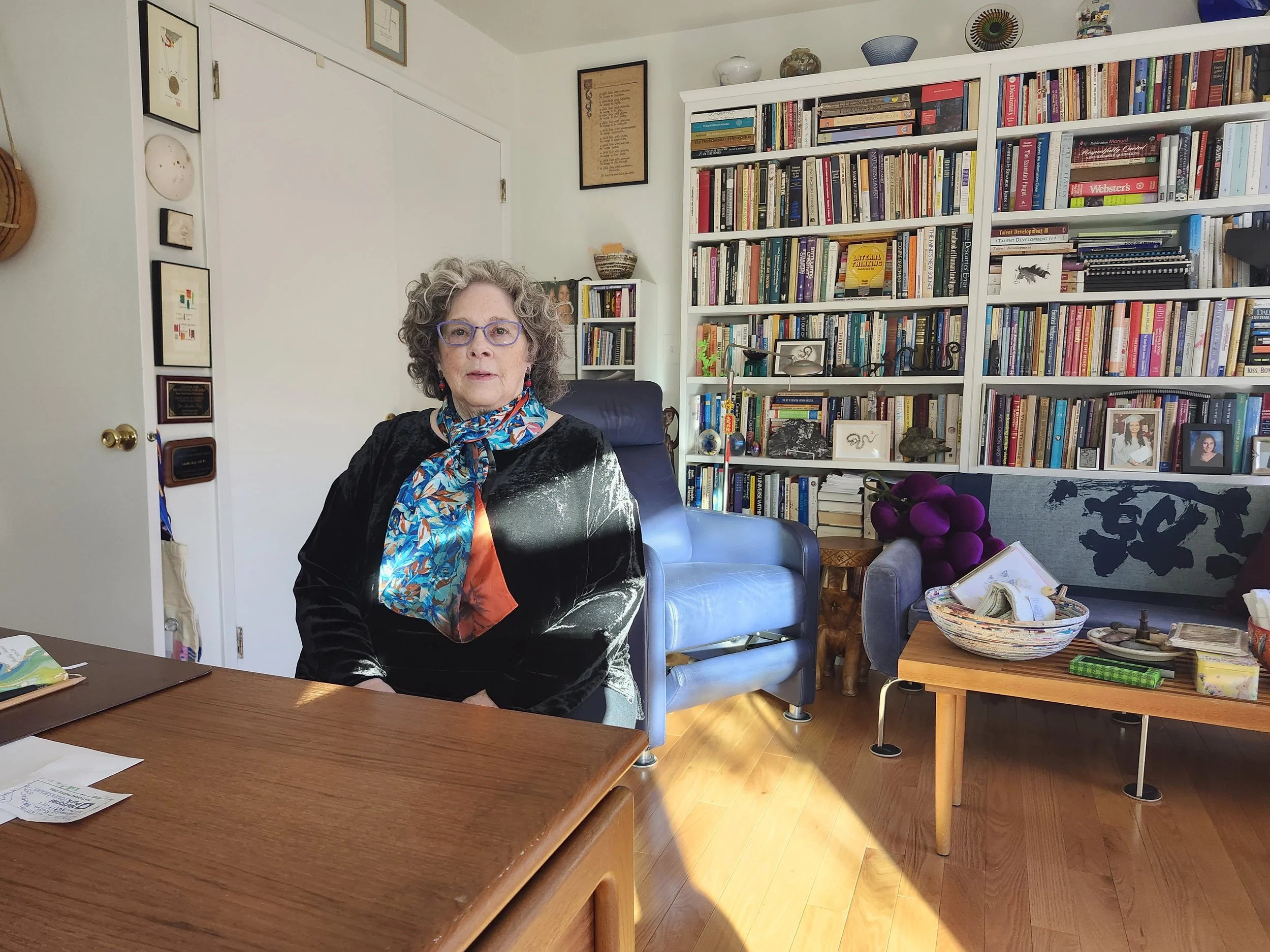
Sandra I Kay, EdD
A Life Devoted to
Creative Potential
Dr. Sandra I. Kay is an educator, researcher, author, instructional strategist, and documentary filmmaker whose work explores how curiosity, wonder, and aesthetic literacy contribute to the development of creative thought and expertise.
Her perspective is grounded in more than three decades of K–12 education, including nearly two decades coordinating gifted programs in New York State. Trained first as an art educator, Kay earned both bachelor's and master's degrees in Art Education before completing an MEd in Instructional Practices in Special Education and an EdD in Special Education at Teachers College, Columbia University. She subsequently remained at Teachers College for ten years as a Visiting Scholar.
Across these roles, Kay has pursued a set of interconnected questions: What roles do curiosity and wonder play in the creation of new ideas or the pursuit of happiness? What makes an idea worth sustained attention? In what ways might personal aesthetic preferences guide creative choices? And what educational experiences allow developing talents to become increasingly sophisticated forms of creative expertise?
Those questions have connected her work on Elegant Problems across art education, gifted education, creativity research, talent development, and instructional design—ultimately offering elegant solutions such as the Talent Profile.
An Educator’s Questions
Dr. Kay’s scholarship grew from questions that emerged through teaching. Her early training and practice in art education drew her attention not only to what learners created, but to how they noticed, chose, explored, and decided what was worth pursuing.
Her doctoral research at Teachers College, Columbia University examined problem-finding and problem-solving among professional artists, semi-professional artists, and non-artists. The research revealed the significance of a personal aesthetic factor in distinguishing professional artists from the other groups and opened a line of inquiry that would continue throughout her career: the role aesthetic preferences play in directing attention and creative thought.
As a Visiting Scholar at Teachers College, Kay continued exploring these questions in conversation with the work of A. Harry Passow, Abraham J. Tannenbaum, Morris I. Stein, and Howard Gruber. Tannenbaum’s developmental model of gifted children, Stein’s work on the contribution of the audience to the creative process, and Gruber’s work on creative individuals—particularly his network of enterprise concept that maps problem-solving pursuits in the lives of accomplished creators—helped Kay recognize another question.
If creative contributions at their highest levels are frequently described as elegant solutions, what qualities of a problem invite the possibility of an elegant solution?
For Kay, that question connected research with educational practice. Rather than waiting to see who might eventually produce exceptional creative work, educators could consider the qualities of the problems, experiences, and environments they provide learners that would invite appreciation if not actualization.
That insight became the first characteristic identified in Elegant Problems.
Following Creative Development Over Time
Kay’s engagement with Howard Gruber’s studies of accomplished creators also drew her attention to the patterns of pursuits that develop across a lifetime. Rather than understanding talent through isolated accomplishments, she became interested in the relationships among interests, questions, independent investigations, and developing expertise across domains and over time.
Gruber’s concept of a network of enterprise would inform two related strands of Kay’s work: the development of Elegant Problems and, subsequently, the Talent Profile Record, a way of documenting the developing pattern of a learner’s interests, pursuits, and accomplishments over time.